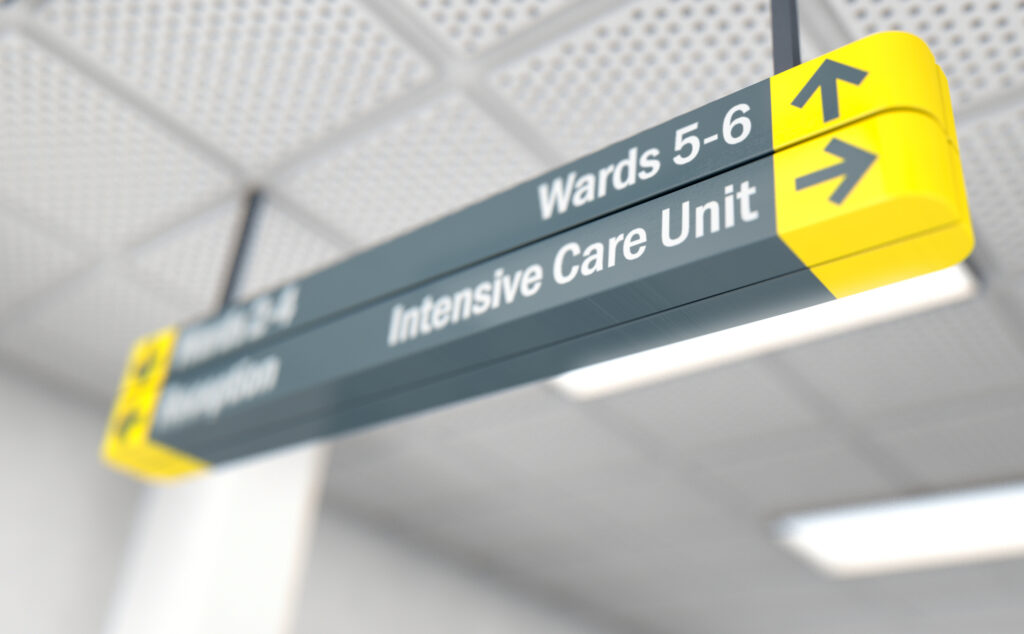
Having a child admitted to a paediatric intensive care unit (PICU), for even a short time, is a frightening and upsetting experience for parents, close family and friends. It can also be an upsetting experience for the child, whether or not they remember exactly what happened.
Here Dr Simon Nadel, Consultant in Paediatric Intensive Care, explains how parents can mitigate some of the impact of time in the PICU – but also what to do if you think you or your child is suffering from post-traumatic stress as a result.
If your child is already receiving specialist help, you should follow your specialist’s advice.
There are of course many reasons for a PICU admission, and many medical consequences. Often, a child is admitted to PICU as an emergency or after major surgery, which must have been extremely stressful.
Once a child has recovered enough to no longer need the level of specialist support that they have been receiving in PICU, they are ready to go to the ward before they are discharged home. This is good news but causes most parents to be anxious. This in itself can be a difficult transition.
How can we minimise the stress associated with transfer from PICU to a general
paediatric ward?
1. If possible, try to become involved in your child’s Discharge Care Plan. Find
out the transfer plans in advance if you can, such as approximately what time of day your child will be transferred, what the name and phone number of the ward will be and where it is.
2. There will be fewer staff on the general ward but remember this is because your child does not now require such close supervision and has been assessed as not needing intensive care or high dependency care.
3. Remind yourself that the transfer from PICU is a positive change. There may
be some clear advantages to being on a general ward – for instance your child may not need to be attached to monitors, you may be able to get more involved in your child’s care, you may have access to a playroom or classroom together, or the visiting hours
may be different and you may be able to stay next to your child at night.
The next step after the general paediatric ward is usually discharge home.
These are some of the common reactions children experience after coming home from PICU:
• Being more clingy to parents, siblings or other adults;
• Behaving like a younger child, for example bed wetting or thumb sucking again;
• Being afraid of the dark;
• Changes in sleeping pattern, including having upsetting dreams;
• Changes in feeding/eating behaviour;
• Being excessively restless, overactive or finding it difficult to stay focused
(for example when playing);
• Complaints of headaches, tummy aches or other minor complaints.
A child who has spent a lot of time in PICU will have suffered enormous disruption to their routines and may not be sure where boundaries lie. Life will also have moved on; time will have passed (as it would if your child had not been ill) and what was an age-appropriate rule before admission may no longer be.
“Acting-up” in a previously obedient young child is a common reaction when a child has been through a difficult event.
Many of these reactions are part of the normal stress response in children and should recover on their own after 3-6 months.
In children with learning difficulties or developmental delay, the same reactions are commonly seen, but they might be shown differently, depending on what was usual behaviour for the child before their admission to PICU.
It is important to let your child’s mind do the work of sorting out what they have been through, at their own pace.
After a trauma or upsetting experience, the mind naturally selects which memories to play over and then moves on.
Do allow your child to think about what has happened.
Don’t insist that your child talks about their experience. But, when they are ready to, make sure you sit down and listen, and if they are old enough, ask them what they are feeling. This is their mind’s way of naturally “processing” what has happened and trying to make sense of it.
Consider making a story or diary together. It can be useful to make a story of everything that happened before, during and after the PICU admission.
You could stick in photos or your child’s drawings. Doing this together might help to fill in some of the “blanks” for both of you.
Try to answer your child’s questions about what happened honestly and use the right language for their age if you can.
Some younger children might play act their time of illness by playing with dolls or figures or drawing or painting it. Again, this is a normal reaction to an upsetting event and helps the child’s brain to make an understandable story out of what has happened to them. Do not be alarmed if this play appears repetitive.
In terms of helping your child with their behaviour, remember that part of loving your child is giving them clear rules and limits to what is acceptable behaviour and what is not.
As with all parenting, good behaviour can be maximised by following the four simple steps known as “CICC”:
• Tell your child clearly exactly what the desired behaviour is, e.g. “I’d like you to put away your toys in the box now”.
• Immediately reward the desired behaviour by noticing it and giving an appropriate amount of praise.
• Only praise your child for that task if they have done it, so the reward is contingent on their behaviour.
• Be consistent and always notice good behaviour, follow-through the consequences you have told your child.
Research has shown that punishments are in general less effective than clear, well-timed rewards at changing and maintaining good behaviour.
It is usually a good idea to start parenting the way you mean to go on as soon as your child is discharged from PICU.
Of course, extra time together, cuddles and demonstrations of love are definitely part of good parenting!
Some children might want to get back to their old routines of returning to nursery, pre-school or school, being with friends and extended family soon after discharge from PICU.
Other children might need more time on their own than before.
Usually after a few weeks it is possible to gradually start to get back to their old lives, putting the experience in the past and feeling grateful that it is over.
Studies have shown that most children are very resilient and will recover naturally from an upsetting event, as long as they are supported to do this.
After about 3-6 months, if your child has any of the following symptoms, they may need some help to ensure good emotional recovery:
• Being extremely upset, tearful or angry when reminded of the PICU admission or things to do with it;
• Re-living the PICU admission either in upsetting dreams or feeling as if it were happening all over again, right now, as “flashbacks”, or seeing or hearing things which aren’t there related to the upsetting events;
• Severely disturbed sleep;
• Poor concentration compared to before the PICU admission;
• Appearing “jumpy” or easily startled;
• Avoiding reminders of the events such as hospital programmes on TV, smells or
tastes to do with the illness;
• Feeling detached or separated from normal life, appearing withdrawn and not wanting to join in things which they used to enjoy.
Taken together, having several of these symptoms may mean your child has post-traumatic stress disorder (PTSD). This is a kind of memory disorder, where traumatic
memories seem to be stored in the wrong part of the brain. It is as if our mind won’t let go of things it hasn’t put in the right place. The good news is it is very treatable (more on this later).
These are some of the common reactions in parents after their child has had an
admission to PICU:
• Feeling as if everything is happening “in a daze” or they are functioning “on autopilot”. This is a continuation of the normal stress reaction all of us have to enable us to cope with extreme situations. It will usually fade gradually, and things will start to feel “real” again.
• Worrying a lot more than before about their child being safe and being overprotective.
• Feeling that they can’t cope with looking after their child’s medical needs on their own.
• Trying to be strong at all times and not allowing themselves feel any emotion.
• Feeling guilty for being upset, when perhaps other people’s children did not do so well.
• Poor sleep, poor appetite and poor concentration.
• Using too much alcohol, cigarettes or food to cope with difficult emotions.
It is very important to be aware that these responses are normal. It does not mean you are a bad parent.
Most often these reactions will recover on their own after 3-6 months. However, as with all traumas either directly experienced or witnessed, people can have more long-lasting
troubling effects. This may include post-traumatic stress disorder or PTSD.
When a child is hospitalised, there is a significant change in family routines and focus. The impact of this on the brother(s) or sister(s) of the hospitalised child includes over-reacting to changes in routines, getting anxious about being away from parents, and feeling confused and left out.
Hospitalisation of a brother or sister has also been shown to affect a sibling’s concentration, sleep, and appetite, and to increase loneliness and worry for their own health.
Some simple strategies have been shown to improve how siblings cope with their brother or sister being in hospital, such as:
• Parents staying in touch with them, for instance by video-calling (e.g. using apps like FaceTime or WhatsApp) when they can’t be together
• Parents keeping them informed and explaining in age-appropriate language what is happening to their sister or brother;
• Ensuring the siblings’ routines are kept as normal as possible;
• Parents allowing the sibling time to talk about how they feel and ensuring they do not think of their brother or sister’s illness as somehow their fault;
• Involving siblings, if appropriate, in creating the story of the admission.
Siblings who are themselves very young may become more “clingy” than before and show some of the behaviours mentioned above.
It is important that parents make time for siblings as much as they can. If possible, perhaps try taking it in turns to spend time at home with them.
Learning, both in everyday experience and at nursery, pre-school or school, is a huge
part of any child’s life.
Learning may be disrupted by many of the things already talked about above.
For example:
• The child may have lost their routines and be unsure of what is expected of them; they may have temporarily gone back to an earlier developmental stage and feel fearful of separating from a parent or carer; they may have missed significant amount of nursery or school and may find it hard to settle back in and catch-up.
• Behavioural problems may appear or re-appear and should be dealt with using the broad principles given previously, in close conjunction with their nursery worker, teacher or other staff who are involved in their learning.
• Your child’s ability to learn may also be affected both by the effects of stress on the brain and by the effects of their illness and the actual medical procedures they have had.
It may be some months before it becomes clear whether they have lost any skills they previously had, but it is important to remember how resilient young children and their brains are, and how well most children cope with re-learning developmental skills.
Here are some suggestions to help manage any learning problems (it is worth highlighting these to their teacher if appropriate):
Slowed information processing
The young person may need less work to be given to them when they get back to school, and extra time allowed for class work, homework and exams. Instructions in class may need to be broken down into small parts and repeated to ensure understanding.
Short-term memory problems
This can be caused by many mechanisms, including the effect of PTSD on the brain. Recommendations include:
• breaking down complex information into meaningful “chunks”;
• having material provided in written as well as verbal formats;
• encouraging the child to engage in active reading strategies (e.g. highlighting and underlining words) to help them remember key information;
• solving problems in maths by writing down every step, so they don’t lose track of their place.
Recommendations include:
• Providing multiple opportunities to learn and recall the same information;
• learning from experience e.g. activities and experiments;
• using images, mind-maps and diagrams to remember things;
• using reminders on mobile phones or e-mail as cues.
Attention problems
This may partly be caused by tiredness. The child may need more frequent breaks whilst studying and extra sleep on school nights.
If learning problems seem severe, it may be necessary to seek specialist advice to assess the child at school.
It is important to understand that most children who are discharged from PICU will be back to their normal selves within a few weeks. Only a small proportion will develop longer term problems, lasting more than 3 months. Some children will have problems associated with whatever caused their admission to PICU, and these should be discussed with their specialist during their follow up where appropriate.
Around 20% of children will develop PTSD after PICU admission, but it is important to remember that PTSD is a treatable disorder in both children and adults, but is likely to need the professional help of a psychologist, specialist doctor or nurse.
The treatment for PTSD involves helping you or your child to do some of the things described above, such as working through the trauma through talking, playing or drawing, to make sense of it and “file it away” in the right part of the brain.
You need to be able to put the experience into words. If parents have been using too much alcohol, cigarettes, medication (including painkillers), or food to cope with difficult emotions, it may be that this is delaying natural recovery from post-traumatic stress symptoms and you might need some help with these coping behaviours.
Treatment processes the memories so that they don’t keep popping into your child’s thoughts when they don’t want them to.
If you think you, your partner or your child might have PTSD, you should get in touch with a health professional or Camp Simcha.
You can also discuss this with your GP to refer you for expert help. All treatments should be given by PTSD specialists.


From time to time, we may contact you by email, phone and post to keep you updated on our work and ways you can support us. You can change the way you hear from us at any time by emailing us at office@campsimcha.org.uk or calling us on 020 8202 9297. To help us to work more efficiently, we may analyse your information to make sure you receive the most relevant communications. This may include using publicly available information. You can ask us to stop this at any time, by contacting us using the above details. You can read more about how we use your information in our privacy policy.